


You’ve saved the reference photos. You know the general direction — higher bridge, more defined tip, a cleaner profile. That’s a starting point.
What it isn’t, is a surgical plan.
The nose that looks right on someone else’s face is a product of their bone structure, their skin thickness, their forehead angle, their chin projection. On a different face, the same nose can look off in ways that are hard to articulate but immediately visible. This is what rhinoplasty consultation is actually for — and why the conversation that happens before surgery matters more than most people expect.
There Is No Universal “Best” Nose
Rhinoplasty trends shift. The “Dolly” nose of the early 2000s gave way to a preference for natural, undetectable results. What stays constant is that a nose designed around a trend rather than a face ages poorly — not because the nose changes, but because the trend does, and the disconnect becomes visible.
The goal of a well-planned rhinoplasty is not a nose that looks good in isolation. It is a nose that makes the rest of the face look more balanced. A nose that draws attention to itself has failed at its primary function.
How Surgeons Actually Analyze the Nose
Experienced surgeons assess the nose as part of a set of facial relationships, not as a standalone structure. Two measurements are central to every profile plan.
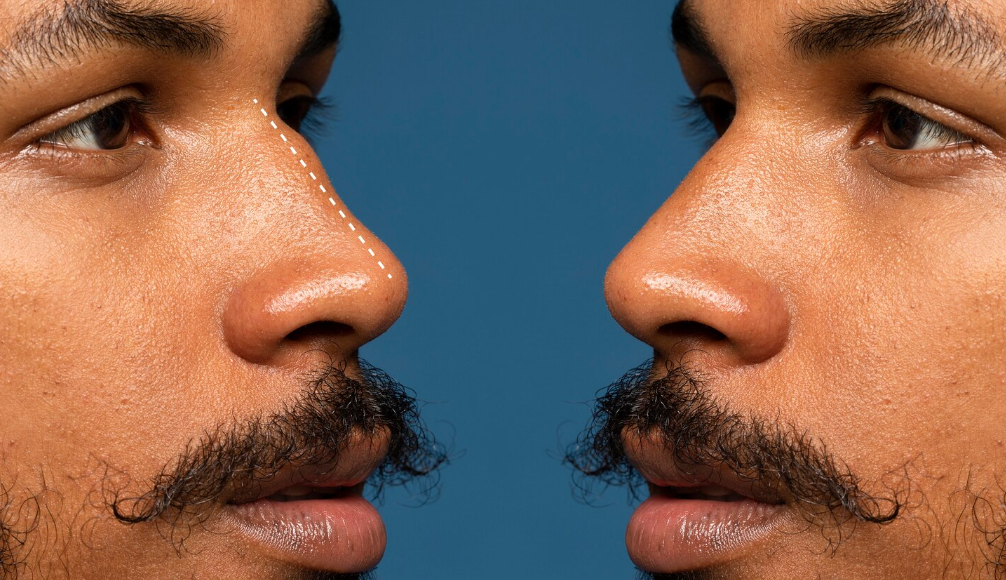
The nasofrontal angle is where the forehead ends and the nasal bridge begins. The ideal range for a natural result is 115° to 130°. When this angle is too wide, the nose appears to emerge directly from the forehead and looks flat or heavy. When it is too narrow, the nose looks detached and the features appear severe. The bridge should start at approximately the level of the upper eyelash line — a landmark that varies from person to person.
The nasolabial angle is the angle between the base of the nose (columella) and the upper lip. For women, the preferred range is 95° to 105°, creating a soft, slightly upturned profile. For men, 90° to 95° is standard — a more perpendicular, straight projection that maintains a strong profile without over-rotating the tip. In patients with a protruding mouth, this angle often appears more acute, and correcting the nose without addressing that relationship can produce an imbalanced result.
These are not arbitrary numbers. They are the angles at which the nose integrates with the rest of the face rather than competing with it.
How Face Shape Changes What Fits
The skeletal structure of the face determines which nose proportions will read as balanced.
On a round face, the goal is usually to add vertical definition — a higher bridge and refined tip creates a line that visually lengthens the face. A short or button nose on a round face emphasizes width.
On a long or oval face, over-lengthening the nose adds to the elongation. A straight profile or a very subtle curve works better. A droopy tip makes the face look longer.
On a square or angular face, a softer curved silhouette balances the strong jaw angles. A sharp, pointed tip on a wide jaw can look aggressive rather than refined.
On a heart-shaped face, proportionality is the priority. The bridge should not visually dominate a delicate chin. The focus is usually refinement rather than augmentation.
None of this is decided by looking at reference photos. It is decided by looking at the patient’s face — from the front, the side, and in three dimensions.
The Nose Types That Require Different Strategies
Each nose type presents a different structural challenge. The same result cannot be achieved using the same technique on different anatomy.
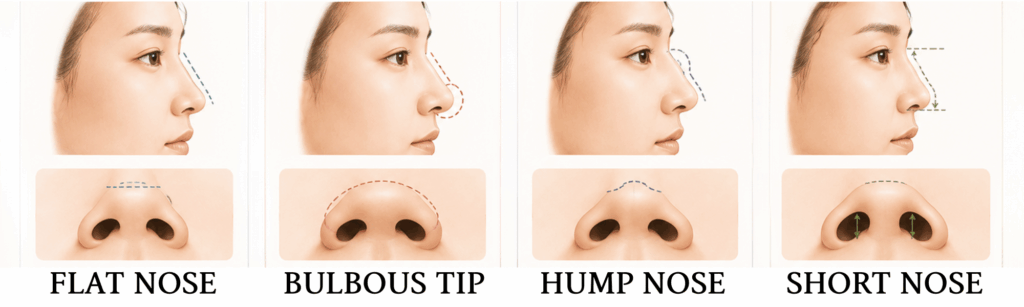
Flat nose (low bridge)
Simply inserting an implant creates height, but without internal structural reinforcement, projection may not be stable long-term. Skin thickness and septal cartilage strength both affect what height is safely achievable and how it will hold.
Bulbous tip
A round, wide, or fleshy tip is typically the result of wide lower lateral cartilages, thick skin, or excess soft tissue between the skin and cartilage — often a combination of all three. Cartilage reshaping through suture techniques can narrow and refine the tip. For patients with thick skin, structural cartilage grafting is often necessary to provide the framework that allows definition to show through. Simply removing tissue on thick skin without adding structure underneath can leave the tip looking shapeless.
Hump nose
Reducing the dorsal hump requires controlled bone reduction while preserving the structural integrity of the bridge. Removing too much without proportion control can create a scooped or irregular profile that reads as operated rather than refined.
Short nose
Lengthening a short nose is one of the most structurally demanding rhinoplasty cases. The nose resists elongation, and without adequate internal support — typically a septal extension graft — projection gained during surgery can contract back over time. Long-term stability depends entirely on the internal framework, not the immediate postoperative result.
Deviated nose
Not just cosmetics, functional rhinoplasty. Requires a multidisciplinary approach where plastic surgeons and ENT specialists collaborate. Unlike standard cosmetic rhinoplasty, which may compromise structural integrity to achieve a smaller shape, functional rhinoplasty prioritizes the patency of the airway. This often involves strengthening the nasal valves and straightening the septum while refining the external appearance.
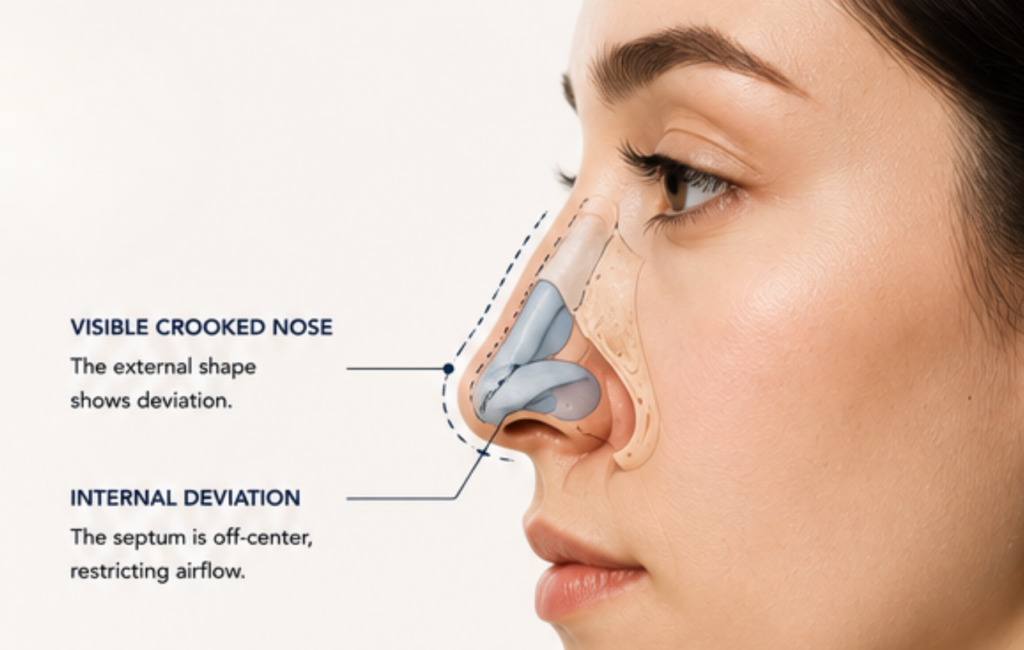
Read more in detail -> Deviated septum (Functional rhinoplasty)
Why Before and After Photos Can Mislead You
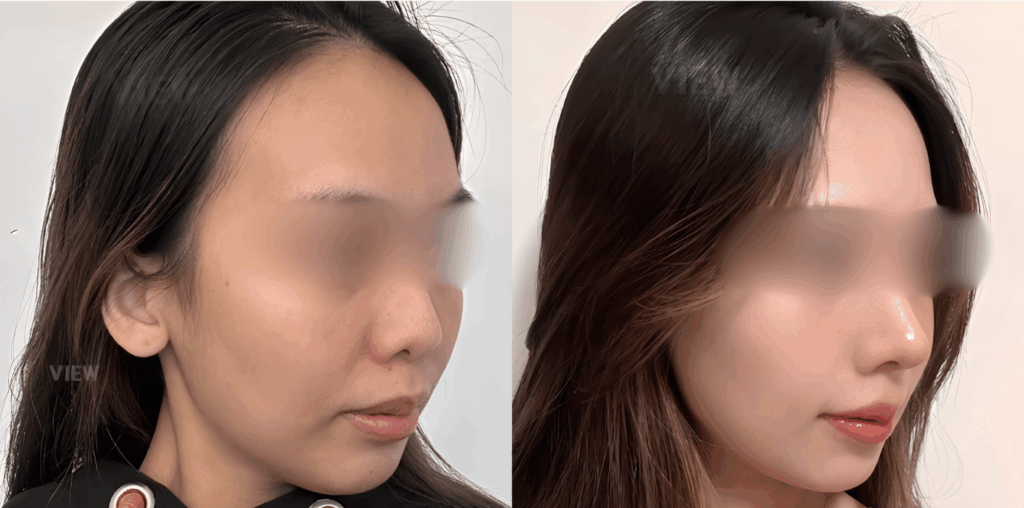
A before and after photo shows surface change. It does not show the cartilage support behind it, the skin thickness working with or against the result, whether grafts were used, or what the nose will look like in five years.
Two patients can look similar in before photos and require completely different surgical strategies. A result that looks sharp one month post-surgery may lose projection over time if the internal structure was not designed to hold it. Conversely, a result that looks slightly swollen at six weeks can settle into a natural, stable shape at twelve months.
Evaluating rhinoplasty results means understanding that true stability is assessed after full healing — typically at the six to twelve month mark, when swelling has resolved and soft tissue has adapted to the new framework.
Why the Consultation, Design, and Surgery Must Be Done by the Same surgeon
This is not a small detail.
The surgeon who performs your consultation develops a specific understanding of your anatomy, your proportions, and what is achievable for your face. The design that emerges from that conversation — the angles, the bridge height, the tip projection — is built around that specific assessment.
When a different surgeon performs the surgery, that understanding does not transfer. Measurements on paper are not the same as the judgment built during an in-person evaluation. The plan exists in the context of the surgeon who made it.
This is one of the standards Miin applies when selecting partner hospitals. The surgeon who consults, designs, and operates must be the same person. It is non-negotiable.
What a Good Consultation Actually Covers
A rhinoplasty consultation that is doing its job goes beyond “what do you want it to look like.” It assesses:
Breathing function, to identify any structural issues that affect airflow and need to be addressed alongside cosmetic work. Skin thickness, which determines how much definition is achievable and what techniques are appropriate. Cartilage strength, which affects what can be supported structurally. Previous surgical history, which changes what anatomy is available and how the tissue will respond. Facial proportions, using the angle and ratio analysis described above, to determine what will integrate with your face rather than sit on top of it.
Photos you bring are useful as a communication tool — a way of expressing the direction and character of what you want. They are not a target. A surgeon who confirms your reference photo without analyzing your anatomy is not doing a consultation.
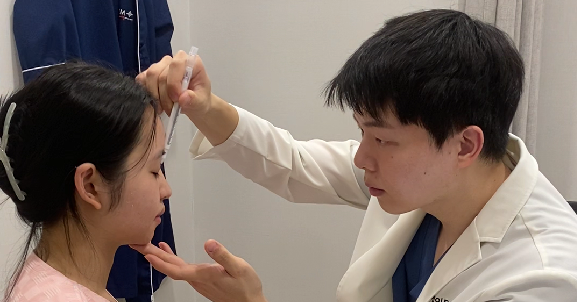
Miin coordinates consultations partner hospital-level clinics in Korea held to a strict standard, including the requirement that the same surgeon consults, designs, and performs your surgery. Get in touch to start planning your trip.