

Most people discover they have a deviated septum one of two ways. Either a surgeon mentions it during a routine examination, or they’ve spent years dealing with one-sided nasal congestion, poor sleep, and chronic fatigue and finally start looking for answers.
It’s one of the most common structural conditions in the nose, and one of the most commonly overlooked.
What a Deviated Septum Actually Is
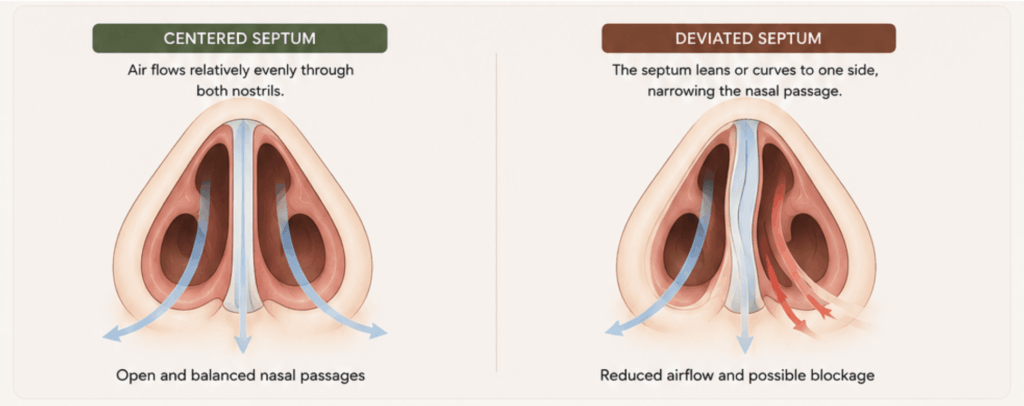
Inside the nose, a wall of cartilage and bone runs down the center, dividing the nasal cavity into two passages. This wall is called the nasal septum. In a centered septum, air flows relatively evenly through both nostrils.
A deviated septum is when this wall leans or curves to one side, narrowing one nasal passage and sometimes almost completely blocking it. The deviation can be present from birth, or it can result from an injury like a fall, a sports collision, or even a birth-related trauma that went unnoticed.
Most people’s septums are not perfectly centered. A minor deviation causes no meaningful symptoms. The issue arises when the deviation is significant enough to restrict airflow, and that threshold is different for every person.
What It Does to the Body
A deviated septum is not just a structural detail. When one nasal passage is substantially narrowed, the effects compound over time.
- Chronic nasal obstruction. One nostril feels perpetually blocked, regardless of whether you have a cold or allergies. Decongestants help temporarily but the blockage returns as soon as the medication wears off.
- Disrupted sleep. Reduced nasal airflow forces the body toward mouth breathing, particularly during sleep. This increases snoring, contributes to dry mouth, and in more pronounced cases, is associated with obstructive sleep apnea — fragmented sleep that leaves the person chronically tired regardless of hours slept.
- Recurring sinus infections. The nasal passage doesn’t just carry air — it filters and humidifies it, and drains the sinuses. A deviated septum can obstruct normal sinus drainage, creating an environment where mucus accumulates and bacteria thrive. People with significant deviations often report a pattern of recurring sinus infections that antibiotics temporarily resolve but never fully prevent.
- Frequent nosebleeds. The deviated side of the septum is often exposed to drier, faster-moving air. This dries out the nasal lining and increases susceptibility to nosebleeds.
- Facial pressure and headaches. In some patients, the obstruction creates pressure that radiates across the face, particularly around the sinuses and behind the eyes.
The cumulative effect is a quality-of-life issue that most patients adapt to so gradually they stop recognizing it as abnormal. The persistent tiredness, the half-blocked nose, the disrupted sleep — it becomes the new normal, until correction reveals how much was being lost.
When Functional Rhinoplasty Is the Answer
Medication manages symptoms. Nasal sprays reduce inflammation temporarily. Antihistamines help if allergies are a contributing factor. But none of these correct the structural deviation causing the problem.
Functional rhinoplasty — specifically septoplasty, the surgical correction of the septum — is the only treatment that addresses the deviation itself. The surgeon reshapes and repositions the deviated cartilage and bone to restore a centered, open nasal passage.
This is a structural correction, not a cosmetic one. The external appearance of the nose is not the goal. The goal is an unobstructed airway.
Open vs. Closed Approach
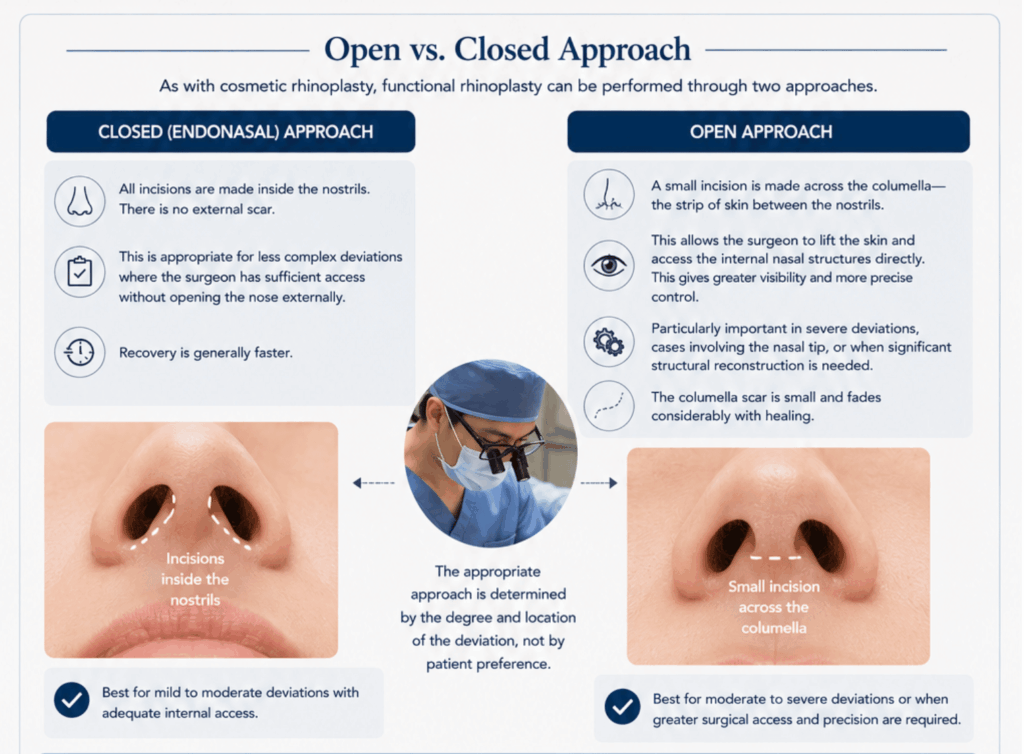
As with cosmetic rhinoplasty, functional rhinoplasty can be performed through two approaches.
Closed (endonasal) approach
All incisions are made inside the nostrils. There is no external scar. This is appropriate for less complex deviations where the surgeon has sufficient access without opening the nose externally. Recovery is generally faster.
Open approach
A small incision is made across the columella; the strip of skin between the nostrils, allowing the surgeon to lift the skin and access the internal nasal structures directly. This gives greater visibility and more precise control, which is particularly important in severe deviations, cases involving the nasal tip, or when significant structural reconstruction is needed. The columella scar is small and fades considerably with healing.
The appropriate approach is determined by the degree and location of the deviation, not by patient preference. A surgeon who recommends the same approach for every patient is not properly assessing the anatomy.
When Functional and Cosmetic Goals Overlap
Many patients with a deviated septum also have a visibly crooked nose — the external shape reflects the internal structural imbalance. In these cases, functional rhinoplasty and cosmetic rhinoplasty are planned and performed together.
This is surgical logic. When the nose is structurally corrected from the inside, the surgeon is already working within the nasal architecture. Addressing the external shape at the same time avoids a second surgery, a second recovery, and the risk of an aesthetic result that doesn’t match the underlying structure.
For patients who are planning rhinoplasty for cosmetic reasons and also have breathing issues they’ve normalized, the consultation is the right time to raise both. A comprehensive nasal assessment before surgery should include internal function, not just external appearance.
What Recovery Looks Like
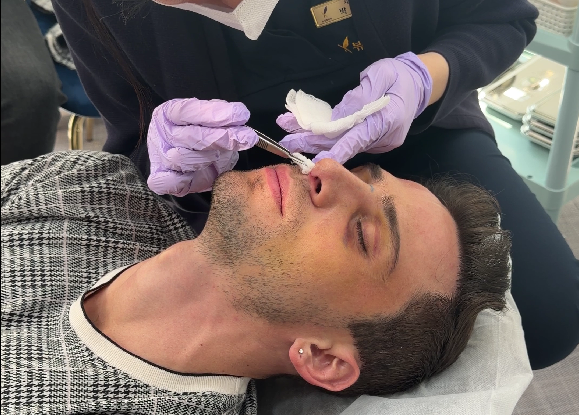
Most patients notice an improvement in breathing relatively early in recovery, even before all swelling resolves, because the structural obstruction has been removed. The full result — both functional and cosmetic — is visible at around 6 to 12 months.
For international patients, a minimum of 7 to 10 days in Seoul is recommended. This covers the pre-surgical assessment, the procedure, initial recovery monitoring, and any required follow-up before flying home.
One Thing Worth Checking Before Any Rhinoplasty
If you are planning rhinoplasty for cosmetic reasons like tip refinement, or anything else, and you have any history of nasal obstruction, mouth breathing, snoring, or recurring sinus issues, mention this at your consultation.
A cosmetic result built on an uncorrected structural problem is a less stable result. Knowing the full picture before surgery allows the surgeon to plan for both, and means you come out with a nose that looks the way you want and functions the way it should.
Miin coordinates consultations with partner hospital-level clinics in Korea that is rigorously selected. If you’re considering rhinoplasty — cosmetic, functional, or both — we arrange a full surgical assessment as part of your trip.