




The most common misunderstanding about facial contouring surgery is that it is a procedure designed to make the face smaller. It is not.
Facial contouring surgery adjusts the proportions and structural balance of the facial skeleton. The goal is not reduction. It is realignment. A face that appears broad, heavy, or asymmetric often looks that way not because the bones are too large in absolute terms, but because their proportions are unbalanced relative to the rest of the face. Correcting that imbalance through precise repositioning and reshaping of the cheekbones, jaw, and chin is what facial contouring actually does.
Why the Amount of Bone Removed Is Not the Point
This is the principle that separates good facial contouring outcomes from poor ones.
Two patients can have the same volume of bone removed during surgery and see completely different results. One looks naturally refined. The other barely changes. The difference is not the quantity of bone removed but how the skeletal structure was realigned; in what direction, to what position, in relation to the rest of the face.
A cheekbone can be repositioned inward to reduce lateral projection, which narrows the face from the front. The same bone repositioned in the wrong direction can leave the face looking wider or create hollowing. The surgical plan determines the outcome far more than the scale of correction.
This is why facial contouring surgery cannot be evaluated by before-and-after photos alone. A result that looks clean in a frontal photo may look operated on from the side or oblique angle. True evaluation requires looking at the face from all directions — which is exactly what the consultation and imaging phase is designed to enable.
What Facial Contouring Addresses
Facial contouring surgery targets three main structural areas. These areas are anatomically connected, meaning adjustments to one typically influence how the others are perceived. Planning is often done across all three simultaneously rather than in isolation.
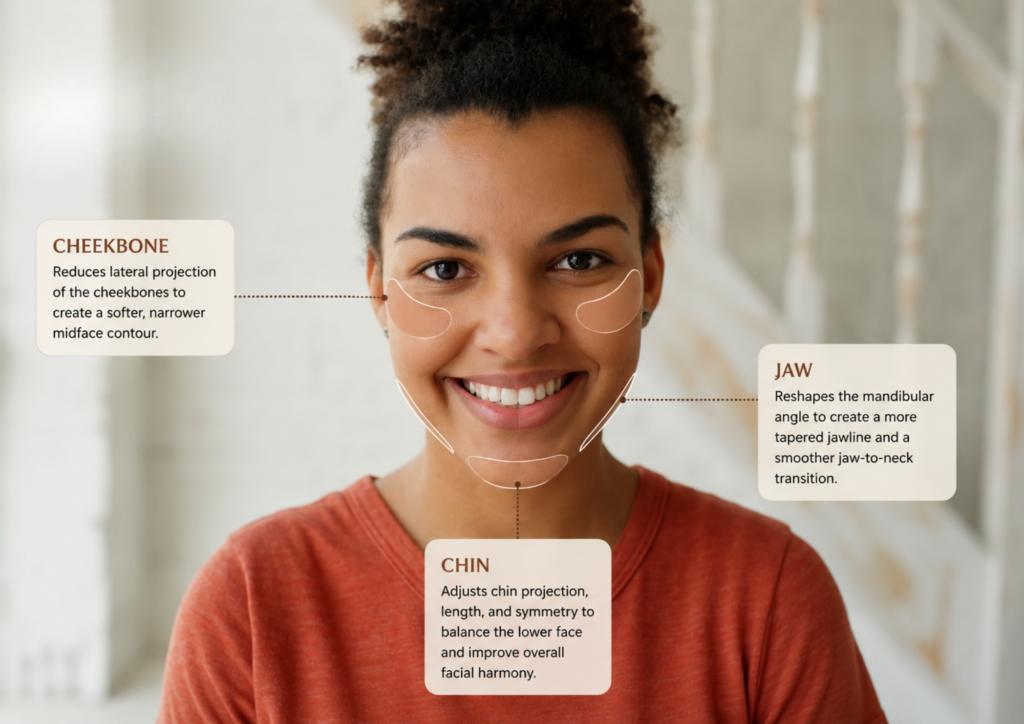
Cheekbone reduction (zygoma contouring). The cheekbones determine how wide the face appears from the front and how much three-dimensional projection the midface has. When the zygomatic arch protrudes laterally, the face can appear broad or angular. Cheekbone reduction repositions the bone inward, narrowing the midface and softening the contour without flattening the cheek structure. The goal is a smoother transition, not an absence of definition.
Jaw reduction (mandibular angle reduction). The mandibular angle sits at the back corner of the lower jaw. When this is enlarged or prominent, the lower face appears square, heavy, or masculine. Mandibular angle reduction reshapes this area, creating a more tapered jaw-to-neck transition. It is frequently combined with chin contouring because the jaw and chin together define the shape of the lower face from both the front and the side.
Chin contouring (genioplasty). The chin contributes to facial length, projection, and alignment. A receding chin makes the nose and lower face appear more prominent. An overprojecting chin can make the profile look imbalanced. Genioplasty repositions or reshapes the chin bone — adjusting projection, length, or lateral symmetry — to bring the lower face into proportion with the upper and middle thirds.
These three procedures are often performed together in what is commonly called a three-set or V-line contouring plan. Whether all three are needed, or only one or two, is determined entirely by the individual’s skeletal structure.
When Contouring Alone Is Not the Whole Answer
Facial contouring surgery has clear limits, and understanding them is as important as understanding its capabilities.
When the primary concern is skin laxity, facial sagging, or aging-related soft tissue descent, contouring addresses none of these. Adjusting the underlying bone does not lift sagging skin, restore lost volume, or correct the downward migration of fat compartments that occurs with age.
When facial width is driven by fat rather than bone, liposuction or buccal fat removal addresses the concern where contouring would not.
A thorough consultation identifies which of these factors is actually driving the patient’s concern. Treating the wrong layer, bone when the problem is soft tissue, or vice versa produces a result that misses the point regardless of surgical precision.
The Consultation and Imaging Phase
Facial contouring surgery requires a level of preoperative analysis that most other procedures do not. Because the procedure operates on bone rather than soft tissue, the planning must account for structures that cannot be assessed visually from the outside.
3D CT scanning reveals bone thickness, the position of the inferior alveolar nerve (which runs through the jaw), the degree of asymmetry between sides, and the exact spatial relationships between the cheekbones, jaw, and chin. Without this imaging, surgical planning is based on guesswork. With it, the surgeon can design a precise adjustment range that is specific to that patient’s anatomy.
The nerve pathway is particularly important in jaw surgery. The inferior alveolar nerve controls sensation in the lower lip and chin. Surgical planning must account for its location to avoid disruption that can affect sensation in the lower face. This is one reason facial contouring in Korea involves imaging as a standard requirement rather than an optional step.
Miin provides medical check up before surgery, without additional cost. A detailed consultation and your result is very important to us.
Recovery: What Is Different About Bone Surgery
Facial contouring involves bone, not just soft tissue. Recovery reflects this.
The initial phase is more significant than most soft-tissue procedures. Swelling is more pronounced and takes longer to resolve. Most patients look presentably recovered within two to three weeks, but the face continues to change over months as the bone heals and the soft tissue adapts to the new skeletal shape.
The final result is typically visible at three to six months. Judging the outcome at six weeks is premature and will almost always look more swollen or less defined than the final result.
Dietary restrictions apply during the bone healing phase. Patients are advised to follow soft food guidelines while the bone stabilizes in its new position. Most oral incisions heal within one to two weeks. Strenuous activity is restricted for several weeks.
International patients planning facial contouring surgery in Korea are generally advised to stay a minimum of two weeks. This covers the pre-surgical imaging and consultation, the procedure, the most critical early recovery phase, and post-surgical follow-up before flying home. For more complex multi-procedure plans, a longer stay is recommended.
Why Korea Leads in This Field
Facial bone contouring is a high-specialization field that requires both surgical precision and an aesthetic understanding of facial proportion across diverse bone structures. Korea’s position as the leading destination for this surgery is the result of decades of accumulated case volume, technique refinement, and a competitive specialization environment that has produced surgeons with a depth of experience in this category that most markets cannot match.
Miin’s partnered surgeons also operate on a uniquely diverse patient population — Southeast Asian, East Asian, Middle Eastern, and Western patients all present different bone structures, facial proportions, and aesthetic goals. That breadth of experience produces a calibration of technique and proportion judgment that is difficult to develop in lower-volume environments.
The imaging standards, the intraoperative safety protocols, and the post-operative monitoring systems at major Korean hospitals reflect that this is treated as a complex surgical category, not a routine procedure.
How Miin Approaches Facial Contouring Patients
Facial contouring is one of the highest-stakes procedures Miin coordinates. The margin for error is small, the recovery is longer than most procedures, and the planning phase is where the outcome is determined.
Every surgeon in Miin’s partner network who performs facial contouring is selected based on consistent results verified directly by our team — not hospital reputation, not case count on a website. We see the results. We know the surgeons. We know which ones produce natural-looking outcomes across different anatomies, including international patients whose bone structure and aesthetic goals differ from the Korean median.
The same doctor who assesses you in consultation designs your surgical plan and performs your procedure. There are no handoffs. For facial contouring, where the plan is built around a CT scan of your specific bone structure and nerve pathways, that continuity is not a preference — it is the only way the surgery makes clinical sense.

Get in touch to start planning your trip with Miin.