




These two procedures are the most commonly confused in breast surgery. They sound like they do similar things. They don’t.
A breast lift corrects position. A breast augmentation adds volume. Choosing between them, or knowing when you need both, requires a specific assessment of your anatomy.
The Fundamental Difference
Breast augmentation is a volumetric procedure. It addresses underdeveloped or volume-depleted breasts by introducing an implant. The concern it solves is size, specifically, not enough of it. It works best when the breast tissue itself is sitting in the right position but lacks the volume the patient wants.
Breast lift (mastopexy) is a repositioning procedure. It addresses ptosis, the medical term for sagging, by removing excess skin, reshaping the breast tissue, and elevating the nipple-areola complex to a more youthful position. It does not add size. In fact, a lift alone can sometimes result in a slightly smaller appearance because the skin envelope is tightened.
The distinction matters because the wrong procedure for the anatomy produces a poor result regardless of how well it is executed. Trying to correct significant sagging with a large implant without a lift is a common planning error. The implant fills the bottom of the breast while the tissue continues to sag over it, producing what surgeons call the “bottoming out.” The tissue hangs over the implant rather than sitting above it.
How Surgeons Assess Sagging
The degree of sagging is classified using the Regnault ptosis scale, which measures where the nipple sits relative to the inframammary fold of the crease beneath the breast.
Grade I (Mild ptosis): The nipple sits at the level of the fold. The breast has begun to descend but the nipple has not yet dropped below the fold line.
Grade II (Moderate ptosis): The nipple sits below the fold but above the lowest contour of the breast. The breast has descended more significantly.
Grade III (Severe ptosis): The nipple sits at the lowest point of the breast and points downward. This is the most advanced stage.
Pseudoptosis: The breast tissue hangs low, but the nipple remains above the fold. Skin laxity is present, but the nipple position is acceptable.
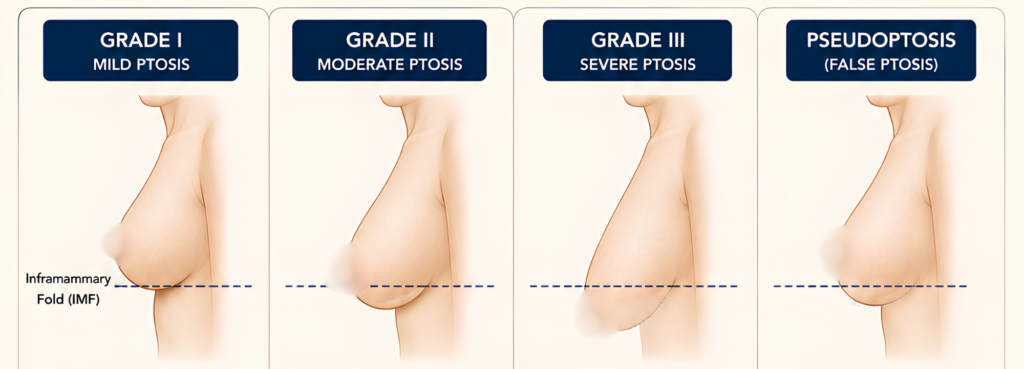
This classification is not just academic. It directly determines whether a lift is necessary, what type of lift is appropriate, and whether augmentation can be added safely in the same operation. A Grade I patient with good skin elasticity may achieve a satisfactory result with augmentation alone. A Grade III patient who receives only an implant will not.
When Augmentation Alone Is the Right Answer

Breast augmentation without a lift is appropriate when the breast has adequate volume distribution but lacks size, or when volume loss has occurred without significant descent.
This applies to: patients with congenitally small breasts where the skin is relatively tight and the nipple sits above the fold; patients who have lost volume after breastfeeding but whose skin has retained sufficient elasticity and nipple position remains acceptable; and cases of asymmetry where different implant sizes can balance the chest without requiring structural correction.
The key assessment is skin elasticity. In younger patients or patients with minimal sagging, the skin can accommodate an implant and the breast will respond well without a lift. As sagging increases, an implant alone produces less and less of the intended result.
When a Lift Alone Is the Right Answer

Mastopexy without augmentation suits patients whose primary concern is position and shape, not size.
Significant weight loss is a common scenario. The breast retains volume but the skin has stretched and the tissue has dropped. A lift repositions the tissue and removes excess skin.
Patients who are satisfied with their cup size but unhappy with how the breast sits are lift candidates. Those who want to be larger are augmentation candidates. The patient who wants both to sit higher and to be larger needs both.
Why the Combination Is the Standard for Most Cases
The augmentation-mastopexy combination achieves what neither procedure can alone. The lift positions the nipple correctly and removes excess skin, creating a firm, conical envelope. The implant fills the upper pole, the area above the nipple, which a lift alone cannot restore. The result is a breast that is both correctly positioned and appropriately full.
The benefit of doing both simultaneously rather than separately is one recovery and a result that is designed as a single unified plan. Staged approaches: lift first, implant later, or implant first, lift later, introduce complexity because the first procedure changes the tissue planes, the skin tension, and the implant pocket dynamics that the second procedure needs to work with.
Mommy Makeover: What It Actually Covers
The term “mommy makeover” refers to a combination of procedures addressing changes that commonly follow pregnancy and breastfeeding. It is a planning approach that addresses the specific changes each patient presents with.
Pregnancy and breastfeeding typically cause: significant volume changes in the breast, often resulting in both size loss and ptosis simultaneously; stretching of the abdominal skin and separation of the abdominal muscles (diastasis recti); and in many cases, changes to the nipple-areola complex — the area most directly affected by breastfeeding.
A typical mommy makeover plan addresses: breast lift, breast augmentation, or both (depending on the degree of volume loss and sagging); tummy tuck (abdominoplasty) to address skin laxity and muscle separation in the abdomen; and liposuction to areas of stubborn fat accumulation.
What most patients don’t anticipate is that the nipples often need correction as well. After breastfeeding, the nipple-areola complex frequently enlarges, elongates, or develops inversion: the nipple retracts inward rather than projecting outward. These changes are separate from breast ptosis, and a breast lift or augmentation alone does not correct them.
Nipple correction is its own surgical topic — and one worth covering in detail. [Read more about nipple and areola correction →]
How Miin Approaches Breast Surgery Planning
Breast surgery is one of the most personal procedures a patient can undergo. The plan has to be built around the individual: her anatomy, her goals, her life stage, and what she wants to feel like on the other side of recovery.
Every surgeon in Miin’s network is handpicked based on consistent results we verify directly, not hospital reputation or credentials on paper. We meet the surgeons personally. We see their work across real patients. We do not send clients to any surgeon whose results we cannot stand behind. That standard applies to every specialty, including breast.
When you plan a breast procedure through Miin, the surgeon who evaluates you in consultation is the same surgeon who designs your plan and performs your surgery. You are not assessed by one person and operated on by another.
From the moment you arrive in Seoul, Korea, to the moment you leave, our coordinator is present. That includes your consultation, surgery day, post-operative appointments, and everything in between. If something comes up during recovery, you are not navigating it alone in a foreign country.
Miin’s services come at no added cost. You pay the hospital directly at the same price as any local patient. The coordination, the translation, the accompaniment, the post-op support: all of it is included.
Get in touch to start planning your trip with Miin.