





Nipple and areola changes are among the most common concerns patients bring to breast surgery consultations, and among the least discussed in general research. Most content about breast surgery focuses on augmentation and lift. The nipple-areola complex sits at the center of the breast’s appearance, and when it has been significantly changed by pregnancy or breastfeeding, no amount of augmentation or lifting fully corrects it.
This is its own surgical category, and it is worth understanding before you finalize any breast surgery plan.
What Pregnancy and Breastfeeding Do to the Nipple-Areola Complex

The nipple-areola complex responds to the hormonal and physical changes of pregnancy before a baby is born. The areola begins to darken and enlarge. The nipple becomes more prominent. These changes are functional, designed to aid breastfeeding.
After breastfeeding ends, these changes do not fully reverse on their own. The areola may remain enlarged relative to the breast. The nipple may have elongated or widened. In some patients, the nipple that once projected outward has inverted, retracting inward due to shortened or fibrous milk ducts. In others, the overall proportion of the nipple-areola complex to the breast has changed enough that the breast no longer looks balanced even after a lift or augmentation.
These are structural changes, not cosmetic preferences. They reflect what happened to the tissue. Skincare and non-surgical treatments do not reverse them.
Three Distinct Concerns, Three Distinct Corrections
Nipple and areola correction is not a single procedure. It addresses three separate anatomical concerns, each requiring a different approach.
Areola reduction
The areola is too large relative to the breast, whether from birth, hormonal changes, pregnancy, or aging. The correction involves an incision around the outer border of the areola. Excess areola tissue is removed and the remaining tissue is sutured at the new, smaller di ameter. The scar sits at the border between the areola and the surrounding breast skin and blends into this natural transition line as healing progresses.
Nipple reduction
The nipple itself is too wide, too long, or both. For patients where breastfeeding function must be preserved, the technique is designed specifically to maintain the milk ducts. A partial incision reduces the nipple width or length while keeping the ductal structure intact. For patients where breastfeeding is no longer a consideration, a more complete reduction can be achieved by sectioning the nipple into segments, removing the middle portion, and suturing the remaining tissue.
Inverted nipple correction
This is the most functionally significant of the three. An inverted nipple retracted inward rather than projecting outward, caused by shortened or fibrous milk ducts pulling the nipple back. Two methods are used depending on severity. The triangular flap method is applied in cases with severe fibrosis, where the duct and fibrous tissue are stretched and released, and a dermal flap supplements tissue if there is insufficient structure to hold the corrected position. For less severe cases, a duct-preserving approach is used. A small incision is made around the base of the nipple, the fibrous band pulling the nipple inward is released, and the milk ducts are stretched rather than cut. The nipple is then fixed in its corrected position with sutures. This approach specifically preserves breastfeeding function and is the standard recommendation for patients who may breastfeed in future.
*Technique may differ based on the patient’s anatomy and main concerns. You will be able to fully understand the surgery method through consultation with your surgeon.
Why Technique Selection Requires a Proper Assessment
The most important variable in nipple correction is whether breastfeeding function needs to be preserved.
For patients who have finished having children, the full range of techniques is available and the surgeon can optimize purely for aesthetic outcome. For patients who may breastfeed again, technique selection must prioritize milk duct preservation even if it limits how much size reduction is achievable in one session.
This is not a question a patient should answer without guidance. It requires an honest conversation with the surgeon about life stage, future plans, and what trade-offs the patient is willing to accept.
The second variable is the degree of the concern. Inverted nipples range from mild cases where the nipple can be coaxed outward manually, to severe cases where dense fibrosis holds it permanently retracted. The surgical plan differs significantly across this range, and it is assessed at consultation through physical examination.
When Nipple Correction Belongs in a Larger Breast Surgery Plan
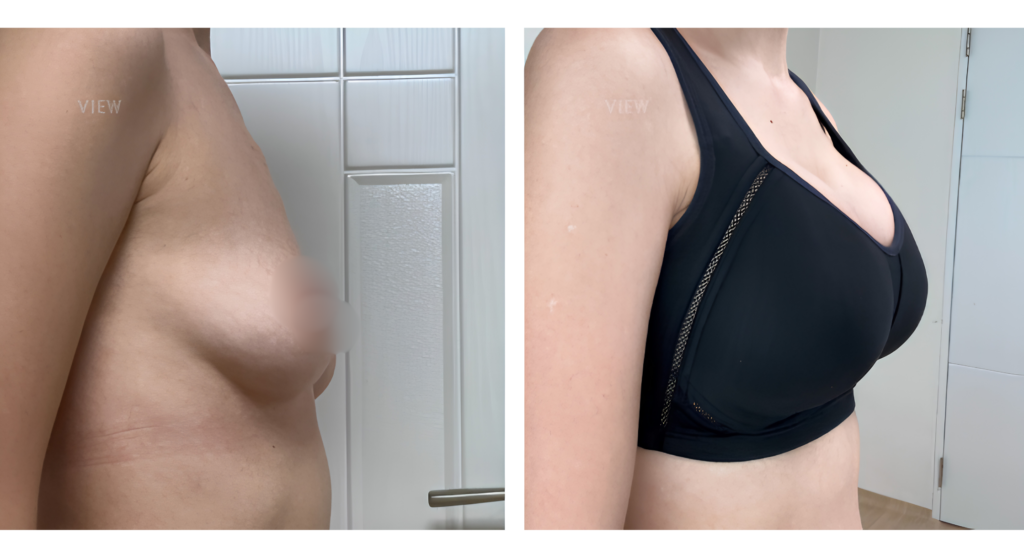
Nipple and areola correction is frequently incorporated into a broader breast surgery plan, particularly in mommy makeover contexts where the patient is already undergoing a lift or augmentation. The clinical reason is straightforward: a lift repositions the breast tissue and the nipple-areola complex with it, but does not change the size or shape of the complex itself. If the areola is large or the nipple is long, those characteristics remain after the lift. Addressing them in the same session produces a more complete and cohesive result.
Similarly, when a breast augmentation changes the overall size of the breast, the proportion of the nipple-areola complex to the new breast size may need to be reconsidered. An areola that looks proportionate on a smaller breast can appear small or disproportionate after significant augmentation. This is worth discussing in consultation before any plan is finalized.
The same incision logic that applies elsewhere in breast surgery applies here: procedures that share anatomical access or that address a connected system produce better results when planned together rather than sequentially.
A Note on Nipple Inversion and Breastfeeding
Inverted nipples are not always post-breastfeeding in origin. Many patients are born with inverted nipples where the milk ducts developed shorter than normal, pulling the nipple inward from the outset. The degree ranges from Grade 1 (nipple can be drawn out manually and stays out temporarily), through Grade 2 (nipple can be drawn out but retracts), to Grade 3 (nipple cannot be drawn out at all).
For Grade 1 and 2 patients who have not yet had children and wish to breastfeed in future, the surgical approach is specifically designed to preserve ductal function. Grade 3 cases with dense fibrosis may require more extensive release, and in these cases there is a genuine trade-off between correction and preserved breastfeeding function that the surgeon must explain clearly before consent.
How Miin Supports This Kind of Planning
Nipple and areola concerns are among the details patients are most reluctant to raise in consultation, particularly across a language barrier with a surgeon they have just met.
Miin’s coordinator is present at every consultation. That presence matters specifically for conversations like this one: where the details are personal, where the patient may need help articulating what she is concerned about, and where the surgeon’s answer needs to be accurately translated in both directions.
The surgical plan that comes out of a consultation where nothing was held back is a better plan. Our role is to make sure that conversation is complete.
Every surgeon in Miin’s network is held to the same standard: the same surgeon who assesses you, designs the plan, and performs the surgery. There are no handoffs. The continuity runs from first consultation to post-operative follow-up.

Get in touch to start planning your breast surgery trip with Miin.