


You may have researched facelifts and assumed that covers everything. For many patients, it does. But there is a specific zone of the face that ages on its own terms and requires its own approach: the midface.
Understanding the difference matters because choosing the wrong procedure for the wrong zone produces a result that looks incomplete, regardless of how well the surgery was performed.
How the Midface Ages Differently
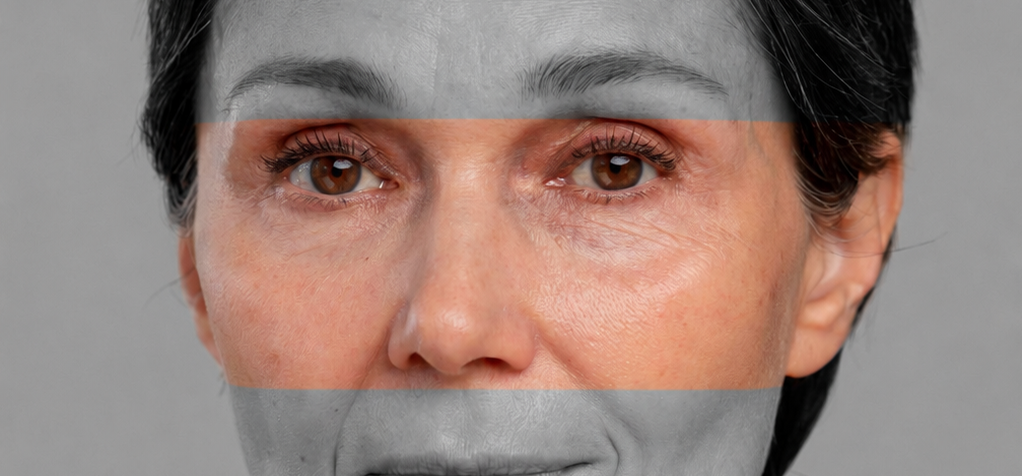
The midface is the central third of the face: the cheek area, the zone beneath the eyes, and the region above the nasolabial folds. The key structure here is the malar fat pad — a triangular fibro-fatty mass that sits beneath the skin of the cheek and gives the midface its fullness and projection in youth.
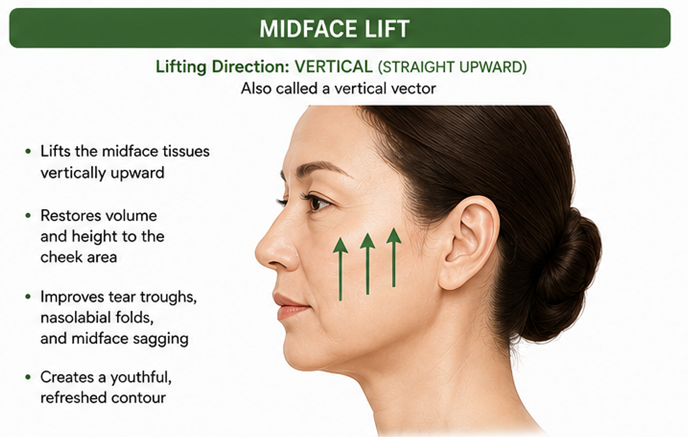
As the retaining ligaments of the malar region weaken with age and gravity, the malar fat pad descends. This descent is primarily vertical. The fat pad that once sat high on the cheekbone drops downward and slightly inward, causing:
Hollowing beneath the eye and along the orbital rim, creating a tired or sunken appearance even when the person is well-rested. Deepening of the nasolabial folds, because the fat that previously sat above them has fallen into and over them. Flattening of the cheek, which loses the convex fullness of youth and transitions instead to a flat or concave profile. A shift in facial shape from the heart-shaped or oval of youth toward a rectangular or bottom-heavy form.
This pattern is well-documented in peer-reviewed surgical literature, which describe gravity and ligament laxity as the primary drivers of malar fat pad ptosis and the downstream effects on the lower eyelid, nasolabial folds, and cheek contour.
Why a Standard Facelift and neck lift Doesn’t Fully Address This
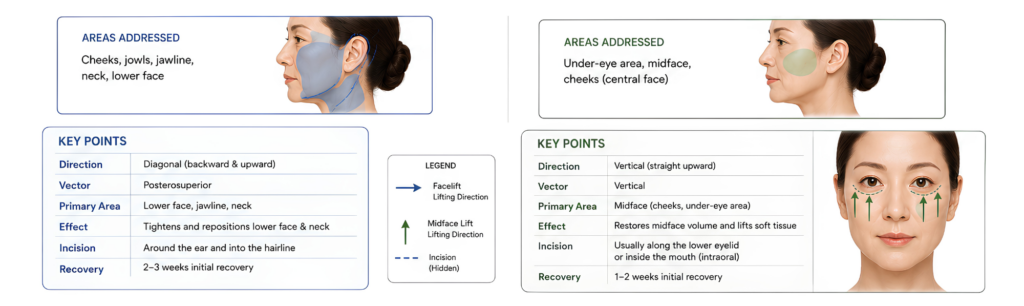
A facelift targets the lower face: jowls, the jawline, and sagging cheeks on the lower part of the face. Traditional facelift approaches work from a lateral approach that lifts tissue horizontally and superolaterally — not in the vertical direction that the midface actually descended.
The midface requires a procedure specifically designed to lift vertically, through a different access point. This is not a flaw in facelift technique. It is an anatomical reality. The lower face and midface are different zones, with different anatomical drivers of aging, requiring different approaches.
What a Mid Face Lift Does
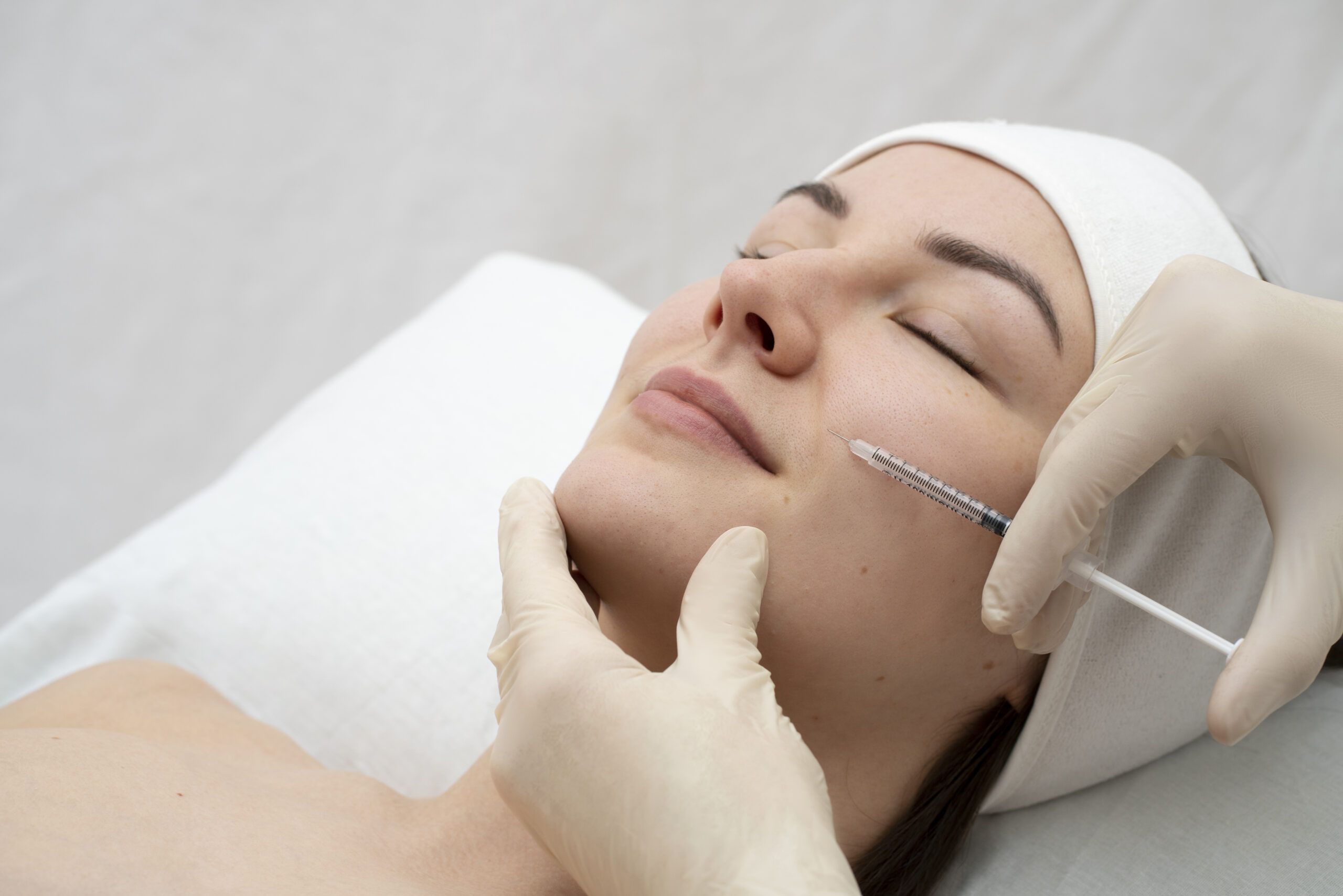
A mid face lift specifically repositions the descended malar fat pad and the overlying soft tissue back to a higher, more youthful position through a vertical vector.
The incision is made as close to the lower lash line as possible, in the same location used for lower eyelid (blepharoplasty) surgery. Through this access point, the surgeon dissects carefully beneath the skin without damaging nerves, lifts the soft tissue vertically, and fixes it in the elevated position using an Endotine device.
The Endotine is a small, FDA-approved bioresorbable implant with multiple tines that hold the lifted tissue over a wide surface area. It provides stable fixation without concentrating tension at a single point, and is absorbed by the body over approximately one year once the tissue has healed in its new position.
The result: restored cheek volume, softened nasolabial folds, and improved support for the lower eyelid, all through a single fine incision that heals within the lash line.
Why It Is Combined With Lower Blepharoplasty
The combination of mid face lift and lower blepharoplasty is not arbitrary. It is anatomically logical.
The lower eyelid and the midface are structurally connected. The malar fat pad sits just below and around the orbital rim. When it descends, it pulls the lower eyelid support structures with it, contributing to lower eyelid retraction, tear trough hollowing, and the under-eye shadow that makes a person look persistently tired.
The incision for mid face lift is made at the lower lash line: the same incision used for lower blepharoplasty. Because both procedures share the same access point, combining them adds no additional scarring. Through that single incision, the surgeon addresses both the under-eye area — fat repositioning or excess skin from the lid — and the midface descent contributing to the tear trough and lower lid appearance.
Doing lower blepharoplasty alone when midface descent is a contributing factor produces an incomplete result. The under-eye area may look better immediately, but the lack of cheek support means the improvement is limited and the lower lid may settle poorly over time. Addressing both zones together produces a more complete and longer-lasting correction of the entire lower orbital and midface region.
This is the same principle discussed in the lower blepharoplasty blog: [Read more about lower blepharoplasty→]
Who Is a Good Candidate
Mid face lift is suited to patients who:
Show sagging limited primarily to the cheek and under-eye area, without significant lower face or neck laxity. Have prominent nasolabial folds driven by fat descent rather than skin excess. Have not achieved sufficient results from non-surgical treatments such as thread lifts or energy-based devices. Want a lifting option with minimal incision and relatively quick recovery.
For patients who have both midface and lower face aging, mid face lift can be combined with a facelift. The two procedures address different anatomical zones and do not compete — they complement each other.
When Mid Face Lift Is Not Enough
A mid face lift is not a substitute for a facelift when jowling, jawline loss, and neck laxity are the primary concerns. It targets the central third of the face. It does not address the lower third.
For patients where aging has progressed across multiple zones simultaneously, the consultation will assess whether mid face lift alone, facelift alone, or a combination of both is the appropriate plan.
How Miin Approaches Mid Face Planning
The mid face lift sits at the intersection of anti-aging and eyelid surgery — a zone where the planning requires the surgeon to assess the under-eye area, the cheek, and the lower lid as a connected system.
Miin’s partner hospitals hold to one standard that matters directly here: the surgeon who assesses you in consultation is the same surgeon who designs your plan and performs your procedure. The integrated assessment required for mid face planning — where the lower eyelid and midface need to be evaluated together — only produces a coherent result when it stays with the same clinician from start to finish.
Our coordinator is present throughout your consultation and recovery, ensuring that the conversation about what is happening at the lower eyelid, the tear trough, and the cheek is fully understood and accurately communicated.
Get in touch to start planning your trip with Miin.