


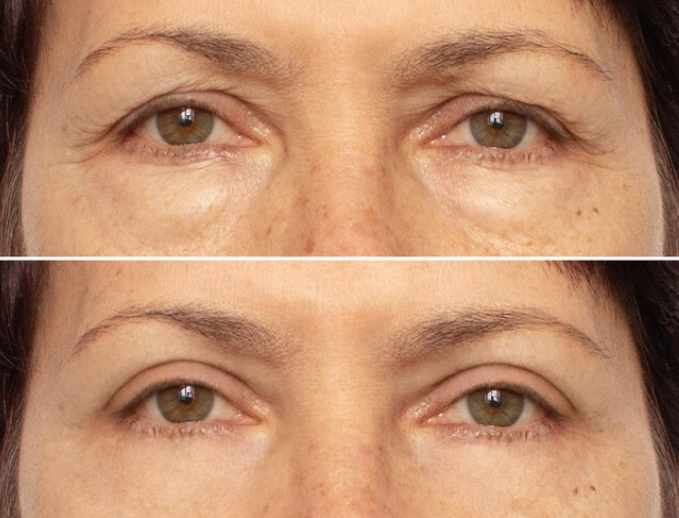
You’ve tried the eye creams. The concealer. The good-sleep routine. And the under-eye area still looks heavy, shadowed, or puffy in a way that doesn’t change regardless of how rested you are.
That’s usually the point people start looking into surgery, and the first question worth answering is why the creams stopped working in the first place.
Why Skincare Can’t Fix This
The under-eye area is one of the thinnest, most delicate zones on the face. Beneath the skin sits a layer of orbital fat held in place by a membrane called the orbital septum. As that septum weakens with age — or, in some people, due to genetics — the fat pushes forward. The result is the puffiness most people call eye bags.
No topical product reaches that fat. Eye creams can improve skin texture and temporarily reduce fluid-related swelling, but they cannot reposition or remove a herniated fat pad. When the source of the problem is structural, the solution has to be structural too.
What Lower Blepharoplasty Actually Does
Lower blepharoplasty is the surgical correction of the lower eyelid, specifically the fat pads, the skin, and the tissue support structures beneath the eye.
What It Addresses
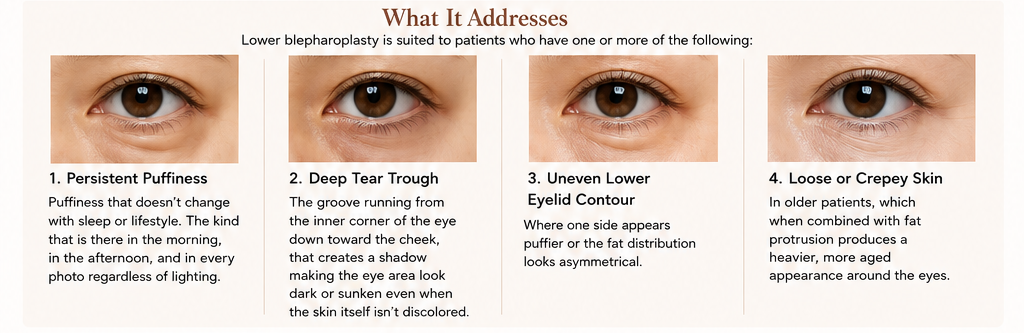
Lower blepharoplasty is suited to patients who have one or more of the following:
Persistent puffiness that doesn’t change with sleep or lifestyle. The kind that is there in the morning, in the afternoon, and in every photo regardless of lighting.
A deep tear trough: the groove running from the inner corner of the eye down toward the cheek, that creates a shadow making the eye area look dark or sunken even when the skin itself isn’t discolored.
An uneven lower eyelid contour, where one side appears puffier or the fat distribution looks asymmetrical.
Loose or crepey lower eyelid skin in older patients, which when combined with fat protrusion produces a heavier, more aged appearance around the eyes.
Recovery: What the Timeline Looks Like
Swelling and bruising peak in the first 48 to 72 hours. Cold compresses and keeping the head elevated help manage this.
By day 4 to 7, bruising begins to shift and reduce. Most patients feel comfortable moving around. If an external incision was used, this window is when initial follow-up is most important.
By week 2, most patients look presentably recovered, though subtle swelling continues. Many are comfortable returning to daily activities.
By month 2 to 3, the result looks settled and natural. Final tissue integration takes this long — judging outcomes too early, especially after fat repositioning, leads to unnecessary worry.
International patients that are doing lower blepharoplasty (if not combined with other procedures) are generally advised to plan for at least 7 days in Seoul. This covers the pre-surgery consultation, procedure, initial recovery, and follow-up before flying home.
Everything including your schedule is coordinated by us, Miin. Get in touch for a free consultation
When Lower Blepharoplasty Is Combined With Mid-Face Lift
The under-eye area and the mid-face are anatomically connected. The fat pad that creates under-eye puffiness sits just above the cheek; the tissue that holds the cheek in place descends from the same zone. When the mid-face begins to drop with age, it doesn’t only affect the cheeks. It deepens the tear trough, increases the shadow under the eye, and makes bags appear more prominent than they actually are.
This is why, for patients in their 40s and above, surgeons frequently recommend combining lower blepharoplasty with a mid-face lift.
The practical reason is the incision. Lower blepharoplasty already accesses the lower eyelid and the area just beneath it. Extending that approach to lift and reposition the mid-face tissue adds meaningful improvement to the cheek area without requiring a separate incision elsewhere on the face. The result is a smoother, more continuous transition from the lower eyelid down through the cheek — something that lower blepharoplasty alone, when the mid-face has descended, cannot fully achieve.
Doing both procedures separately at different times means two recovery periods and the likelihood that the under-eye result will look disconnected from the mid-face result. Done together, the surgeon can balance the two zones as a single unit.
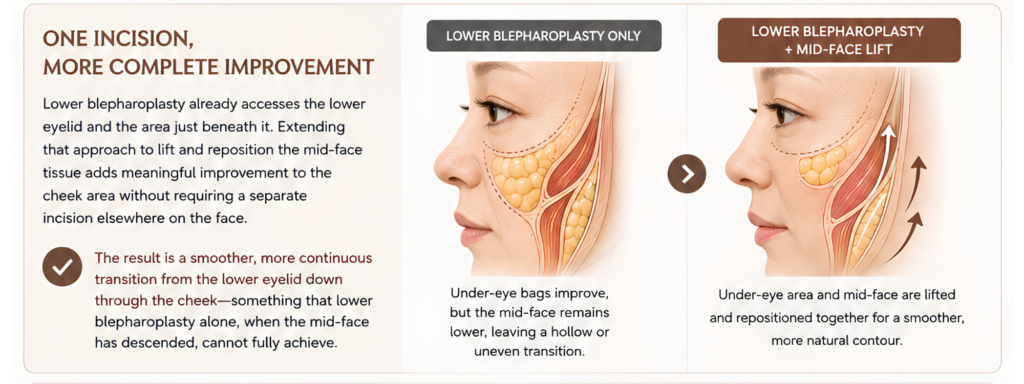
This combination is not always necessary. Younger patients with isolated fat protrusion and good mid-face support do not need it. But for patients where mid-face descent is contributing to the tired or heavy appearance around the eye, addressing only the lower lid produces a less complete outcome.
[→ Learn more about mid-face lift]
What to Know Before Surgery
- Tell your surgeon about any history of dry eye syndrome. Lower eyelid surgery can temporarily worsen dryness, and this affects pre-operative planning.
- Stop blood-thinning supplements — aspirin, fish oil, vitamin E, ibuprofen — at least one week before surgery.
- Avoid alcohol and smoking for at least two weeks before surgery. Both slow healing and affect how tissue responds post-operatively.
- Arrange for someone to accompany you on surgery day. You will not be able to drive after sedation.
- Bring sunglasses. Your eyes will be sensitive to light during recovery.
Skincare and Fillers Are Not a Substitute for the Right Diagnosis
Many patients try tear trough filler before surgery, and in the right cases like mild hollowing without significant fat protrusion, filler is a reasonable short-term option. But filler placed over a prominent fat pad can make the area look heavier, not lighter. And repeated filler maintenance over years adds up, often in ways that delay rather than resolve the underlying problem.
If you’ve had filler and your results keep disappointing, or if you find you need more volume each time to get the same effect, it may be a sign that the issue is structural rather than volumetric.
Miin coordinates consultations at partner clinics with direct relationships and no markup on prices. If you’re planning under eye surgery or considering a combination procedure, we support the entire process from your first consultation to your recovery and departure.