



When people research facelift surgery, the neck is often an afterthought. They come in focused on jowls, nasolabial folds, and cheek descent — and then discover in consultation that the neck is part of the same conversation.
There is a reason surgeons consistently recommend addressing both at once. There is also a reason some patients don’t actually need a neck lift at all. They need something different, and understanding which situation applies to you changes the entire surgical plan.
Why the Face and Neck Age Together
The lower face and neck share anatomy. The platysma; a thin sheet of muscle running from the lower face down the neck connects the two regions structurally. As it loses tension with age, both the jawline and the neck are affected simultaneously.
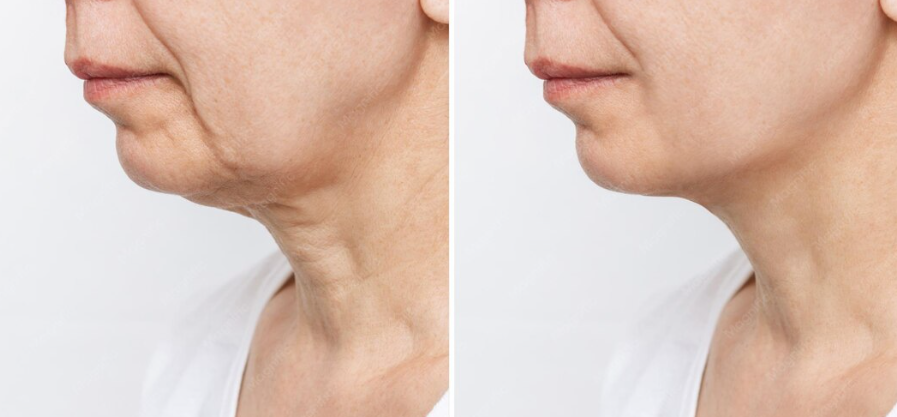
When the lower face sags, jowls form along the jawline and the jaw-to-neck transition softens. At the same time, the neck may develop bands, horizontal lines, loose skin, and a loss of the sharp cervicomental angle, the clean angle between the underside of the chin and the front of the neck that defines a youthful profile.

Because the same structures drive both changes, correcting one without the other produces a result that looks incomplete. A tightened lower face sitting on top of an unaddressed neck draws attention rather than resolving it. This is why facelift surgery and neck lift are so commonly planned together.
What a Neck Lift Does
A neck lift addresses the neck through incisions placed behind the ears, following the natural hairline. Through these incisions, the surgeon accesses your condition, lifts and repositions the tissue, and removes excess skin.
The results are a sharper jawline, a more defined neck contour, and the restoration of the cervicomental angle. Combined with a facelift that has corrected the lower face and jowls, the effect is a unified transition from face to neck that looks natural rather than surgically constructed.
Why the Combination Is Preferred
Doing a facelift without addressing the neck when neck laxity is present creates a visible mismatch. A lifted, tightened lower face contrasts with sagging neck tissue below it.
Beyond aesthetics, there is a structural argument. Lifting the SMAS without considering what connects to it below limits how completely the lower face can be corrected, and how long that correction holds.
When both are addressed in the same operation, the surgeon designs the lift as a single continuous system. Tension is distributed appropriately across the entire lower face and neck rather than concentrated at one point. The result holds more naturally and looks more balanced.
The practical benefit for international patients is one recovery. One trip. One anesthesia. One healing period. Doing them separately means repeating all of that — and the second procedure is always more complex because it operates on tissue that has already been altered.
When You Don’t Need a Neck Lift: Submentoplasty
Not everyone with a neck concern needs a neck lift. For some patients — typically younger, with good skin elasticity — the issue is not excess skin or widespread neck laxity. It is excess fat under the chin and a loosened platysma muscle specifically in that zone.
This is where submentoplasty is the right answer.
Submentoplasty addresses the double chin at its root cause. Through a small 2 cm incision hidden under the chin, the surgeon removes excess fat above and below the platysma muscle, then tightens and sutures the loosened platysma toward the center to prevent it from sagging again. No incisions are made behind the ears.
The result is a firmer, slimmer jawline and a more defined chin-to-neck angle, without the recovery or scope of a full neck lift.
Submentoplasty vs. Neck Lift: How Surgeons Decide
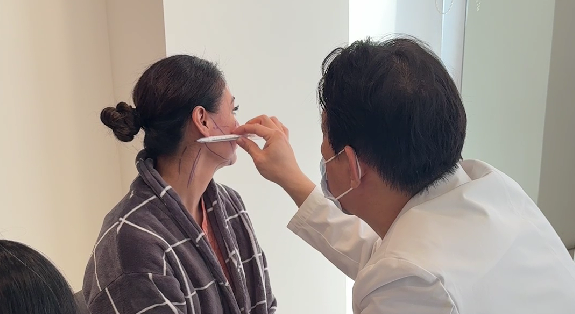
The determining factor is skin laxity — not the presence of fat or the appearance of a double chin.
A patient with excess submental fat, a loosened platysma under the chin, and skin that still has good elasticity is a strong candidate for submentoplasty. The skin retracts after the underlying issues are corrected. The result is clean and defined without touching the neck skin at all.
A patient with significant skin excess in the neck, widespread platysmal laxity, or jowling along the jawline is not. Removing fat and tightening the central platysma on skin that has already lost elasticity produces a result where the skin simply falls more loosely. These patients need skin excision — which requires the incisions behind the ears that define a neck lift.
When Submentoplasty Is Added to a Facelift or Neck Lift
These procedures are not mutually exclusive. Some patients have both widespread facial and neck laxity requiring a facelift and neck lift, and a double chin driven by submental fat and a loosened central platysma.
In these cases, submentoplasty is incorporated into the broader surgical plan. The submental incision allows the surgeon to address fat and the platysma from the front, while the facelift and neck lift work from the sides. Together, they cover the full anatomy — the platysma is tightened and unified across its entire width, and the submental fat is addressed at the same time.
Whether submentoplasty is added, or whether neck lift alone is sufficient, is determined tailored to each and every patient’s condition.
What a Thorough Consultation Covers
For any lower face or neck concern, the assessment should evaluate: the degree of jowling, the condition of the platysma across the full neck, the amount and location of submental fat, the presence or absence of skin excess, skin elasticity, and whether salivary gland enlargement is a contributing factor.
A surgeon who recommends the same procedure to every patient presenting with a double chin or neck laxity is not making a clinical decision. The treatment follows the anatomy.
This is exactly the standard Miin holds its partner hospitals to. Every consultation is conducted by the same surgeon who will design and perform the procedure — no handoffs, no templates. If you’re unsure whether you need a facelift, a neck lift, a submentoplasty, or a combination, get a free consultation with Miin below.
Miin coordinates consultations at rigorously selected hospitals in Seoul, Korea. If you’re considering a facelift, neck lift, or submentoplasty — or aren’t sure which applies to you — we arrange a full surgical assessment as part of your trip.