




One of the first questions patients ask about breast surgery is about scars. Where will it be? How visible? Will it fade? Can I choose?
These are reasonable questions. But understanding the answers requires understanding that incision placement in breast surgery is not primarily an aesthetic preference; it is a clinical decision driven by what the surgery needs to do and what your anatomy allows.
Why Incision Type Matters Beyond the Scar
The incision is the surgeon’s point of access. Where it is placed determines visibility into the surgical field, precision of implant pocket creation, risk of complications, and which procedures can be performed through it.
Incision choice is not separate from surgical outcome. The surgeon’s ability to position an implant accurately, create a pocket with the right dimensions, and manage tissue precisely all depend on the access the incision provides. A patient who selects an incision based on scar preference alone, against the surgeon’s clinical recommendation, may be trading outcome quality for cosmetic preference at the entry point.
Breast Augmentation: The Three Main Incisions
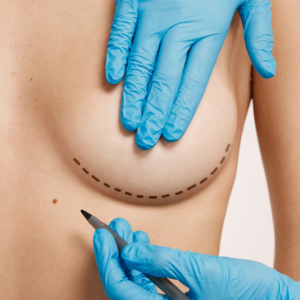
Inframammary (under the breast fold)
An incision is made in the natural crease beneath the breast, where the breast meets the chest wall. This is the most commonly used approach internationally and is considered the most versatile. It allows the surgeon maximum visibility and precise control over pocket creation, which is particularly important for dual-plane placement where the implant sits partially under the muscle. The scar sits within the fold and is covered by the breast tissue resting on top of it. It is not visible from the front, in a bra, or in most swimwear. With proper post-operative care, the scar fades significantly and becomes virtually invisible at normal viewing distance within 12 to 18 months. It is only detectable on close examination when the breast is lifted.
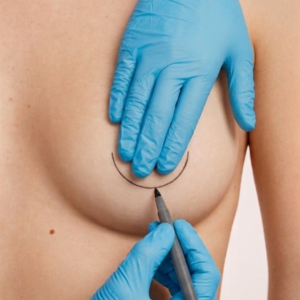
Periareolar (around the areola border)
An incision is made along the lower border where the darker areola skin meets the lighter breast skin. The natural color contrast conceals the scar at normal viewing distance, and once fully healed it is generally not visible. This approach is suited to patients with small to moderate implants and requires the areola to be of sufficient size to allow access.
The periareolar approach passes through breast tissue and glandular structures, which introduces a slightly higher risk of capsular contracture compared to the inframammary approach. There is also a small risk of reduced nipple sensation due to nerve proximity, and a potential effect on breastfeeding ability if milk ducts are disrupted. For patients who have not yet had children and intend to breastfeed, this is worth discussing explicitly in consultation.
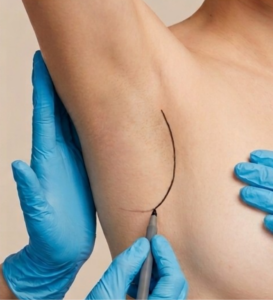
Transaxillary (through the armpit)
An incision is made in the natural crease of the underarm. No scar appears on the breast itself, which is why it is particularly popular in Asian markets. A peer-reviewed 7-year cohort study published in PMC/NCBI notes that transaxillary and periareolar incisions are more frequently used in Asia specifically because of the higher tendency among Asian patients to develop hypertrophic and darkly pigmented scars — making a breast-surface incision more visible in this patient population.
The transaxillary approach uses an endoscope to guide placement through a longer access channel. This increases surgical time and requires additional technical precision. Access to the implant pocket is less direct than inframammary, which can limit pocket adjustability in complex cases. Shoulder mobility may be affected during recovery while the armpit incision heals.
Are the Incisions the Same for Lift and Augmentation?
No. Breast lift surgery requires incisions that the augmentation approach does not.
A lift removes excess skin and repositions the nipple-areola complex upward. The degree of skin removal required determines which incision pattern is used.
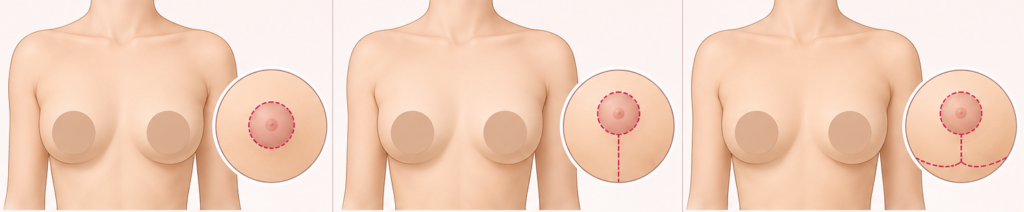
Periareolar (donut) incision
Suitable for mild ptosis. An incision around the border of the areola removes a ring of excess skin and repositions the nipple slightly upward. Minimal scarring, but limited corrective capacity. Not appropriate when significant skin removal or nipple repositioning is needed.
Vertical (lollipop) incision
A periareolar incision is combined with a vertical incision running from the bottom of the areola to the inframammary fold. This allows for more significant skin removal and a more pronounced lift. Suited to moderate ptosis.
Anchor (inverted-T) incision
The most extensive pattern: periareolar incision, vertical incision, and a horizontal incision along the inframammary fold. Used for severe ptosis where the greatest amount of skin removal and nipple repositioning is required. Produces the most comprehensive lift but the most extensive scarring pattern.
When augmentation and lift are combined, the surgeon uses the lift incision to also place the implant. The same access serves both purposes, which is one reason the combination is clinically efficient — one set of incisions, two corrections.
For breast reduction, the vertical or anchor incision patterns are most common because the procedure involves removing significant tissue volume in addition to skin. The incision pattern mirrors what the degree of reduction requires.
Can You Choose Your Incision?
You can express a preference. You cannot override the clinical recommendation.
The surgeon selects the incision based on several factors that are assessed at consultation, not from photos. These include: the implant size and type being placed, as larger implants require more access; the degree of ptosis, which determines which lift pattern applies; the patient’s existing areola size, which determines whether periareolar access is possible; skin quality and elasticity; tissue thickness; and the specific pocket position required.
A patient with severe ptosis who prefers a periareolar incision because the scar is smaller is asking for a correction that the periareolar approach cannot deliver. The incision that produces the smallest scar is not always the incision that produces the best result.
There is room for genuine discussion in cases where multiple approaches are clinically appropriate. In those cases, patient preference is a legitimate factor. What is not appropriate is making incision choice primary and allowing it to constrain what the surgery can achieve.
What Actually Determines How a Scar Looks
Patients often focus on incision location when the factors that most influence scar appearance are different.
Skin type and genetics are the strongest determinants. Patients with darker skin tones have a higher tendency to form hypertrophic scars or keloids — which is precisely why transaxillary incisions are more common among Asian patients in Korea. This is not a cosmetic preference but a clinical consideration that affects the patient’s risk profile.
Surgical technique matters significantly. A well-placed, tension-free closure heals better than an incision made under tension regardless of location.
Post-operative scar management determines how quickly and completely a scar fades. Silicone gel sheets and silicone-based scar gels have the strongest clinical evidence for reducing scar thickness, redness, and elevation. They are typically applied once incisions have closed, from about four to six weeks post-surgery, and used consistently for several months.
Sun exposure directly affects healing scars. UV exposure on a scar less than twelve months old can cause permanent hyperpigmentation. Physical coverage and SPF are non-negotiable for any visible scar during this period.
Most breast surgery scars reach their final, mature appearance between twelve and eighteen months post-surgery. Judging a scar at six weeks or even six months is premature.
On Not Wanting Scars
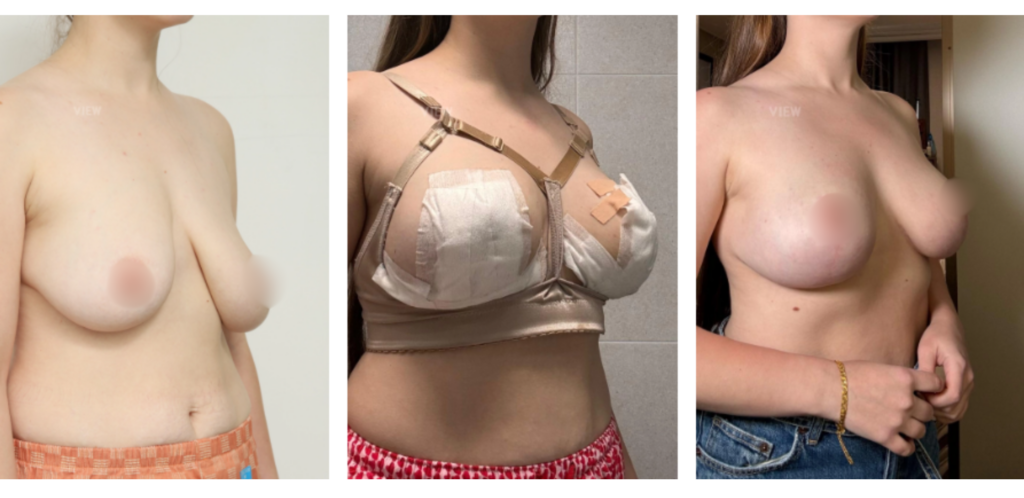
Every incision produces a scar. There is no technique in breast surgery that does not.
What varies is where the scar sits, how visible it is in everyday life, and how well it heals with proper aftercare. The inframammary scar is invisible from the front and covered in all standard clothing. The periareolar scar blends with the areola border at normal viewing distance. The transaxillary scar avoids the breast surface entirely.
What does not exist is a breast augmentation or lift that leaves no trace. A consultation that promises otherwise is not being honest with you.
The realistic goal is a scar that is well-placed, well-healed, and not visible in your daily life. For most patients, across all three incision types, that is achievable with the right surgical plan and proper post-operative care.
How Miin Approaches This Conversation
Incision type is one of the details patients most want to control and least understand clinically. It is exactly the kind of conversation that needs to happen with the operating surgeon directly — not with a coordinator, not through online research, not based on what someone else had done.
When you consult through Miin, the surgeon assessing you is the same surgeon designing your plan and performing your surgery. They will explain why a specific incision is recommended for your anatomy and your procedure, what to expect from the scar, and what the post-operative care involves. That conversation happens in the room, not in a form you fill out online.
Miin’s coordinator is present to ensure that nothing is lost in translation, that your questions are raised, and that the surgeon’s answers are fully understood before you leave the consultation.
Get in touch to start planning your breast surgery trip with Miin.